One approach to artificial intelligence is to mimic the architecture of the (human) brain. The human brain is built up of neurons which are essentially organic logic gates with thousands of (binary) inputs and a single (binary) output. The output is then channeled to thousands of other neurons for use as input.
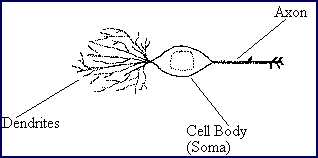 A human neuron |
Note: human neurons are incredibly slow when compared to computers and their gates. The success of the organic brain stems from its massive parallelism. That is, each neuron is "wired" directly to thousands of others, allowing for millions of simultaneous computations. Our silicon based competitors can only perform one computation at a time, giving us as edge! |
| The brain's architecture is simulated by creating layers of "artificial neurons." Each neuron receives input from every neuron in the previous layer and has a rule for determining if it's state will be ON or OFF. |  An artificial Neural Network |